Mini Excavator for Landscaping: A Practical Application Guide
Sep 22, 2026
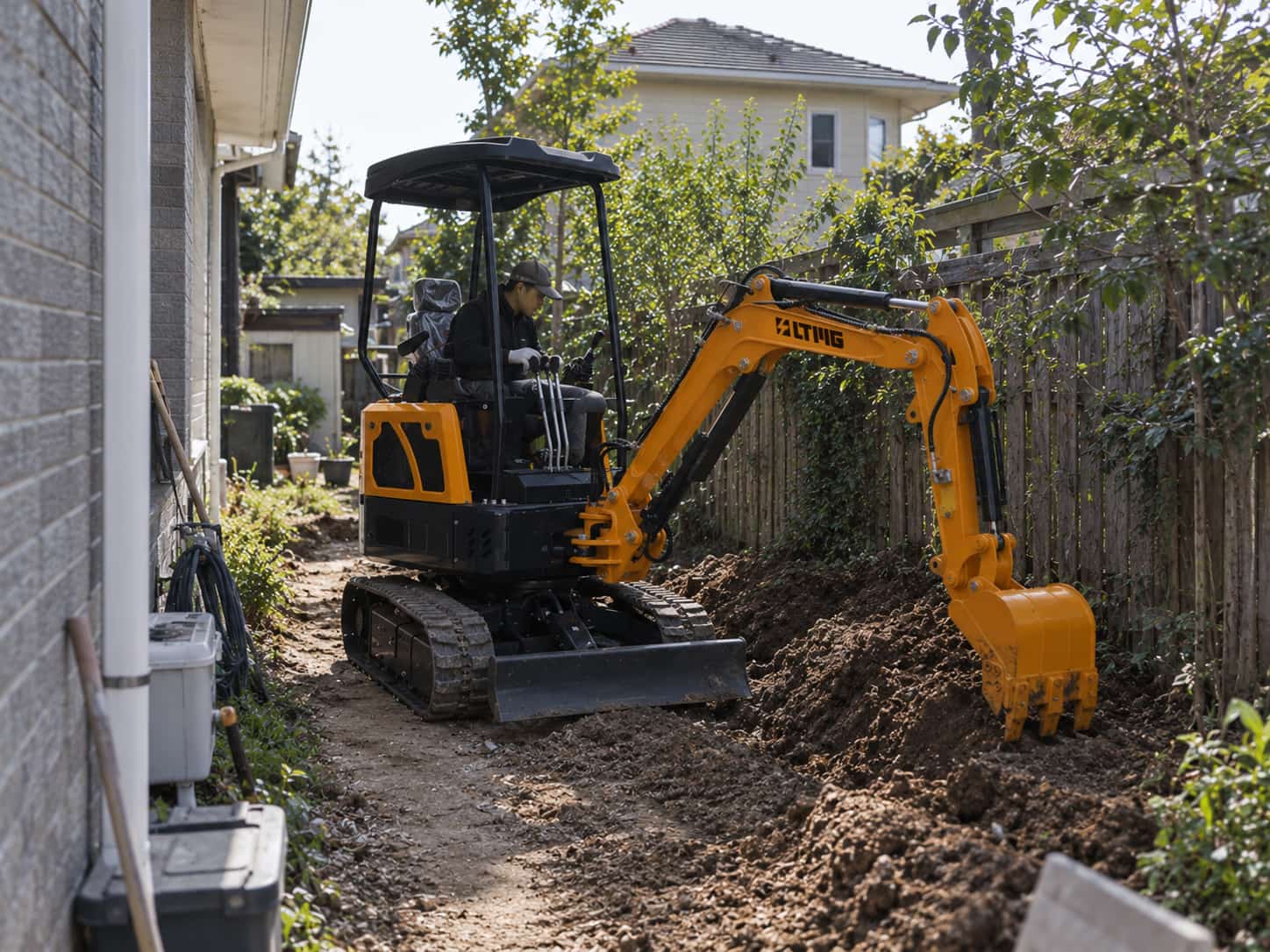
Backyard landscaping often involves more challenging excavation than it first appears: digging a drainage trench beside a fence, creating a pond behind an established garden, or removing roots where a new patio will be built. Choosing a mini excavator for landscaping means considering whether the machine can access the work area, handle the soil conditions, and avoid excessive restoration work afterward. For residential projects, access and working space often narrow the equipment shortlist before digging depth does. A smaller machine may fit through a restricted entrance, but it still needs sufficient reach, digging capability, and stability to complete the work efficiently.
This guide explains how to choose a suitable machine size, select practical attachments, protect existing lawns, and identify equipment configurations that match your needs.
Why Choose Mini Excavators for Landscaping
Landscaping often requires excavation around structures and features that must remain intact. Fences, established plants, paved paths, and nearby buildings can all restrict equipment movement.
A mini excavator can dig and place material within its working reach while remaining in one position. This helps reduce repositioning and unnecessary travel across the site.
Common landscaping applications include:
Drainage installation: Digging drainage trenches and preparing locations for water collection systems.
Garden renovation: Removing excess soil and preparing planting areas.
Pond construction: Excavating the basin and shaping shelves according to the design.
Hardscape preparation: Excavating for patio subgrades, steps, and retaining-wall foundations.
Planting and fence installation: Preparing holes with a compatible auger.
Root and stump removal: Excavating and removing root systems where complete clearance is required.
However, an excavator is only one part of an efficient landscaping equipment setup. If soil must be moved from the backyard to a truck at the street, a compact dumper or loader may also be needed. Faster digging offers limited benefits if the excavator spends much of the day waiting for spoil removal.
A skid steer loader may be worth considering for this supporting role. Loaders are generally better suited to repeated material transport and spreading material over larger areas. Discuss the actual site requirements with the sales team to confirm a suitable equipment combination.
Feedback from a Finnish customer of the LTMG 2-ton mini excavator
Best Excavator Size for Residential Yards
Choose a smaller machine that can complete the work efficiently while providing adequate stability and operating capacity. A machine that fits through the gate but struggles with every bucket of compacted soil may increase labor requirements and project costs.
The following ranges provide a starting point for comparison. These are general application guidelines; actual suitability depends on the specific machine and site conditions.
Operating Weight Class
Residential Applications to Consider
Key Limitations to Check
Approximately 1–2 tonnes
Restricted-access gardens, shallow drainage, and small planting projects
Digging productivity, reach, and ability to handle heavier attachments
Approximately 2–3.5 tonnes
General landscaping, patio preparation, drainage networks, and small pond excavation
Access width, working space, and transport requirements
Approximately 3.5–5 tonnes
Higher-volume excavation, harder soil, larger ponds, and stump removal within the machine’s capabilities
Ground-bearing conditions, site access, and restoration costs
Measure the Entire Access Route
Before choosing a small excavator for backyard work, measure the narrowest usable opening along the entire access route. Account for gate hardware, downpipes, corners between buildings, overhead branches, and changes in ground level.
Compare these measurements with the machine’s actual dimensions rather than relying on its weight class alone. Two machines with similar operating weights may have different widths and clearance requirements.
If the excavator has a retractable undercarriage, check both the retracted and extended widths. Follow the manufacturer’s instructions for the correct working configuration.
Tail swing also matters once the machine enters the work area. A zero-tail-swing design can reduce rear overhang, but the boom, bucket, and attachment still require sufficient clearance.
Check Working Reach and Capacity
Maximum digging depth does not describe every practical working position. When excavating a pond, for example, the bucket may need to reach across a shelf while the machine remains a suitable distance from the edge. Loading soil into a vehicle also requires sufficient dumping height and reach.
When handling rocks or other heavy materials, check the model’s rated lifting capacity at the actual working radius and configuration. Bucket breakout force is not a measure of lifting capacity.
The same care applies to transport planning. Check the combined weight of the machine, attachments, trailer, and other carried equipment against the relevant vehicle and trailer limits.
The LTMG mini excavator range includes several sizes suitable for residential landscaping. Before comparing access dimensions, hydraulic performance, and transport weight, ask our sales team for the specification sheet covering the exact configuration you are considering.
Attachments for Landscaping: Auger, Grading Bucket, Ripper
Useful compact excavator attachments should address tasks your crew performs regularly. Start with the application, then confirm that the attachment matches the machine’s mounting interface, hydraulic specifications, and operating limits.
Auger: Planting Holes and Fence Posts
An auger can save time when a project requires numerous holes of consistent diameter. Common landscaping applications include drilling fence-post holes and preparing planting holes.
Choose the drive unit and bit according to soil conditions, required hole dimensions, and the machine’s hydraulic performance. Loose soil, clay, and rocky ground place different demands on the attachment.
For planting, the finished hole must accommodate the root ball and meet the planting specification. After drilling, the hole may still need widening or its sides loosening, especially where drilling in cohesive soil leaves smooth, compacted walls.
Grading Bucket: Shaping and Finishing
A grading bucket is useful for spreading loose topsoil, shaping gentle slopes and shallow contours, cleaning drainage channels, and finishing pond shelves. Its wider cutting edge helps produce a smoother surface than a narrow toothed digging bucket.
Choose a bucket width and capacity appropriate to the machine and material. An oversized bucket filled with wet soil can affect handling and productivity.
For many projects, a practical sequence is to complete the main excavation with a digging bucket, then switch to a grading bucket for finishing. If the excavator supports the required hydraulic configuration, a tilting grading bucket can help follow contours with fewer machine movements.
A grading bucket prepares the surface, but it does not replace compaction required by the project specification.
Ripper: Loosening Resistant Ground
A ripper concentrates digging force through a narrow tooth. It can loosen resistant ground before the material is removed with a bucket.
For root work, confirm that the specific attachment is suitable for the intended application. Do not assume a general-purpose ripper can efficiently cut every root or remove stumps of any size.
Operate within the manufacturer’s specified limits. Side-loading the attachment or repeatedly applying shock loads to the machine cannot compensate for insufficient digging capacity.
When comparing mini excavator attachments, prioritize tools that address frequent tasks. A well-matched digging bucket, grading bucket, and one regularly used specialist attachment may offer more value than a large collection of rarely used tools.
Working in Tight Spaces While Minimizing Lawn Damage
Rubber tracks do not guarantee an undamaged lawn. Rutting, torn turf, and soil compaction depend on ground conditions, machine loading, turning movements, and repeated travel. The practical goal is to minimize disturbance and account for necessary restoration in the project plan.
Plan a Protected Access Route
Choose the route before unloading. Identify irrigation lines, drainage systems, buried utilities, septic infrastructure, and any ground or paved surfaces with uncertain load-bearing capacity.
Arrange utility locating before excavation. Privately installed lines may need to be identified separately.
Where appropriate, install ground-protection mats rated for the equipment loads and site conditions. Mats help distribute loads and protect surfaces, but they do not make unstable ground or underground structures with inadequate load-bearing capacity safe to cross.
Keep material deliveries and spoil removal on the planned route wherever possible to limit the area exposed to repeated traffic.
Reduce Sharp Turns and Repositioning
Tight pivot turns can tear turf. Plan more gradual turns and minimize unnecessary repositioning, following the machine’s operating instructions.
Position the excavator so it can reach both the excavation and the spoil-receiving area without constantly moving its tracks. Organizing the work area before digging can substantially reduce cleanup and lawn repair afterward.
Keep people outside the machine’s operating area. Where visibility is restricted, use a trained spotter with agreed signals and a position clear of the machine’s travel and swing paths.
Adjust the Schedule for Wet Ground
Saturated soil is more vulnerable to rutting and compaction. If the tracks begin to sink or the surface deforms noticeably, reassess the route and working conditions.
Postponing access may cost less than repairing deep ruts after excavation.
Keep reusable topsoil separate from subsoil, and avoid storing excavated material on planting areas that must be preserved. Lawn protection depends on material storage and cleanup decisions as well as machine operation.
How to Choose a Mini Excavator for Your Landscaping Business
When buying a mini excavator for landscaping, identify its most frequent tasks before comparing models and configurations. For teams focused on residential yard renovations, access and precise control may be the priorities. Contractors who regularly handle larger excavation volumes or hard ground should pay closer attention to digging productivity, stability, and attachment compatibility.
A machine suited to your everyday working conditions offers more purchasing value than one selected simply for a lower price or larger size.
Match the Configuration to Frequent Tasks
Before purchasing equipment, review upcoming projects and identify the two or three tasks the machine will perform most often. This helps avoid spending on rarely used features while reducing the risk of selecting a configuration that limits productivity.
Main Type of Work
Priority Features or Capabilities
What to Confirm Before Purchase
Yard drainage and trenching
A bucket matched to trench width, suitable digging depth, and machine dimensions appropriate for confined spaces
Access width, actual working reach, and spoil placement
Planting and fence installation
A compatible auger and auxiliary hydraulic system
Soil conditions, hole diameter and depth, and auger hydraulic requirements
Pond excavation and terrain shaping
A digging bucket, grading bucket, and sufficient working reach
Pond dimensions, shelf design, and spoil-removal arrangements
Root removal and harder ground
Adequate digging capability and attachments such as a ripper suited to the application
Root or ground conditions, attachment suitability, and machine stability
If daily work involves frequent attachment changes, assess whether a quick coupler could improve efficiency. Confirm its compatibility with each attachment, locking method, and the effect of its added weight on operating capacity.
Include Maintenance Access and Parts Support in the Decision
Landscaping work often takes place across multiple sites. Equipment downtime can disrupt subsequent projects, so maintenance access and parts availability are worth checking before purchase.
Find out whether daily inspection points are easy to reach, common filters and wear parts are clearly identified, and maintenance manuals and parts information are available. Also ask about warranty coverage, technical support, common parts availability, and expected dispatch times.
The purchasing budget should cover essential attachments, transport, routine maintenance, and wear parts—not just the base machine price.
Share Your Working Requirements with LTMG for a Suitable Equipment Solution
If you are comparing the LTMG mini excavator range, start by providing:
Main project types and typical soil conditions.
Narrowest access width and site-space restrictions.
Typical digging depth and working reach.
Required attachments and how often they will be used.
Destination country, expected workload, and purchasing budget.
These details help the LTMG sales team discuss models, attachments, and delivery configurations around your actual requirements. When requesting a quotation, also ask for the specific model’s technical specifications and configuration list so you can compare the details item by item.
FAQ
What Size Mini Excavator Do I Need to Dig a Backyard Pond?
For a small backyard pond, a 2–3.5-tonne machine is a reasonable starting point for comparison. Restricted access may favor a 1–2-tonne model, while a larger excavation or harder ground may require a bigger machine. Before selecting a model, confirm the pond dimensions, reach needed across shelves, safe working position, and spoil-removal plan.
Can a Mini Excavator Remove Tree Stumps?
Yes, provided the stump and root system are within the machine’s capabilities. Feasibility depends on tree species, root spread, soil conditions, decay, access, and attachment choice—not stump diameter alone. Larger or deeply rooted stumps may require a bigger excavator. If complete root removal is unnecessary, stump grinding may cause less disturbance to the surrounding area.
What Specifications and Features Should I Check When Buying a Mini Excavator for Landscaping?
First, confirm that the machine can pass through the site entrance and that its digging depth, reach, and operating capacity suit your regular tasks. Next, check that the required attachments are compatible with its mounting interface and hydraulic system. Finally, confirm the exact engine configuration, documentation required for the destination, quotation scope, warranty terms, and parts support. Providing site dimensions and typical working conditions helps the supplier recommend a suitable machine.